
Suzuki GS750

When Suzuki launched the GS750 in 1976, they took the plunge into the 4-stroke segment. The inline-four with double overhead camshafts was considered bulletproof, and with a solid chassis wrapped in great design, the GS became a very popular motorcycle.
When Suzuki launched the GS750 in 1976, they stepped into the four-stroke segment. The inline-four with double overhead camshafts was considered bulletproof, and with a solid chassis wrapped in great design, the GS became a very popular motorcycle.
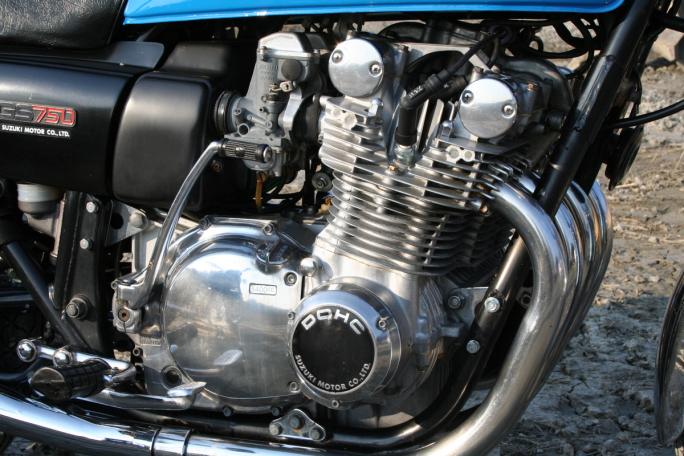
The DOHC engine in the GS750 was almost flawless and rock solid.
By the beginning of the 1970s, Suzuki had a solid position as a motorcycle manufacturer in competition with Yamaha , Kawasaki and Honda . This was the golden age of 2-strokes, and Suzuki could offer a wide range of models. The motorcycles they offered in the TS series, the T series and not least GT series were very popular.
By the beginning of the 1970s, Suzuki had a solid position as a motorcycle manufacturer in competition with Yamaha , Kawasaki , and Honda . This was the golden age of two-stroke engines, and Suzuki could offer a wide range of models. The motorcycles they offered in the TS series, T series, and not least the GT series were very popular.

The GS750 eventually boasted dual front brake discs.
The largest Suzuki, the water-cooled 2-stroke triple GT750, competed in the 750 segment where Honda , Triumph and Norton all offered fast 4-stroke machines. Another troublesome competitor was Kawasaki Z900. The 1973 oil crisis would affect development, eventually forcing 2-stroke manufacturers to think in the direction of 4-stroke production.
The largest Suzuki , the water-cooled 2-stroke triple GT750, competed in the 750cc segment where both Honda , Triumph , and Norton offered fast machines with 4-stroke engines. Another troublesome competitor was the Kawasaki Z900. The oil crisis in 1973 would affect development and eventually forced manufacturers of 2-strokes to start thinking in the direction of producing 4-strokes.

The GS750 received many compliments for its great design and excellent handling.
Suzuki answer to the challenge was the GS750. The model was a success, and charted a new course for Suzuki where GS became a term and synonymous with great design, high quality, and good handling.
Suzuki 's response to the challenge was called the GS750. The model was a success and charted a new course for Suzuki , where GS became a term synonymous with great design, high quality, and excellent riding characteristics.
In 1978, a new GS750 cost NOK 29,500. To put that into perspective, we can mention that this year, 1 liter of gasoline cost about NOK 1.75 and the average annual salary was around NOK 80,000.
In 1978, a new GS750 cost NOK 29,500. To put this in perspective, it can be mentioned that that year, 1 liter of gasoline cost about NOK 1.75 and the average annual salary was around NOK 80,000.
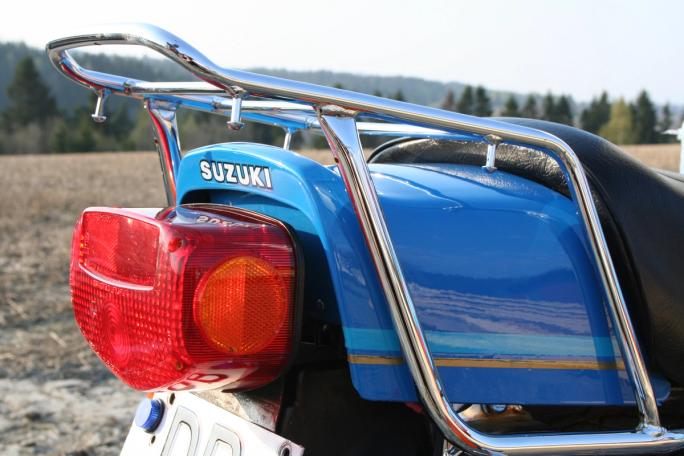
Technical data Suzuki GS750, 1976 model:
- Engine: 4-cylinder 4-stroke, DOHC, air-cooled
- Displacement: 748 cc
- Power: 68 hp at 8500 rpm.
- Torque: 58.8 Nm at 7000 rpm.
- No. of gears: 5
- Front tires: 3.25 x 19
- Rear tires: 4.00 x 18
- Tank: 18 liters
- Weight: 223 kg (dry)
- Top speed: 200 km/h

The GS750 initiated Suzuki 's focus on 4-strokes, and success was immediate.