
Tech tip #6: Chain and sprockets
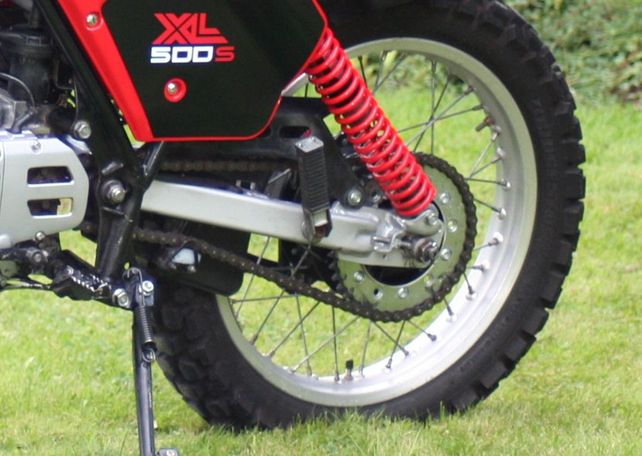
Today's chains and sprockets maintain a high standard of quality, and a well-maintained O-ring chain will last 25,000 km, and often more.
The service life of the chain is mainly determined by two factors; driving style and maintenance. Hard accelerations can stretch the chain, and lack of maintenance and adjustment also affects the service life of the drive package. There are mainly two types of chains. Those without and those with O-rings.

Chains without O-rings require slightly more maintenance than chains with O-rings.
Chain without O-ring. Chains without O-rings were common on motorcycles until the 1970s. This type of chain requires more maintenance compared to the O-ring chain. It must be tightened, cleaned and lubricated at relatively frequent intervals. Experience has shown that the best maintenance is to disassemble the chain and place it in a petroleum-based cleaner/solvent. When chains have been cleaned and dried, it can be advantageous to place it in a small tub of grease. If the grease is lukewarm, it will penetrate the joints, thus providing optimal lubrication. Once this is done, the chain can be dried of excess grease before assembly. Before assembly, it must be checked that the teeth on both sprockets are straight out from the center of the sprocket. If they are bent, it means that they need to be replaced. The chain is installed last, and tightened according to the data provided by the motorcycle manufacturer. A chain that is too tight wears out the bearings on the drive shaft, and a chain that is too loose increases wear on the chain guide. A properly tensioned chain should have a "slack" of about 20-25 mm in the vertical plane (up and down) measured in the middle of the chain when the bike is on the rear wheel. Off-roaders can have "slack" of up to 30 mm due to long suspension travel.

In the 1980s, O-ring chains became standard on most motorcycles
Chain with O-ring. The first O-ring chains were introduced in the late 1970s, and in the 1980s this type was standard on most motorcycles. The O-ring chain is built up as the name suggests, with small O-rings. This keeps the lubricant inside the rollers, while preventing dirt and moisture from penetrating. Typical maintenance of this type of chain is cleaning with a suitable agent, lubricating and adjusting the tension. When it comes to wear on the sprockets, the same visual inspection of the teeth is followed as on the chain without O-ring. The O-ring chain has been further developed and later types are called X-ring and Z-ring. These are chains that have improved sealing rings and have lower friction.
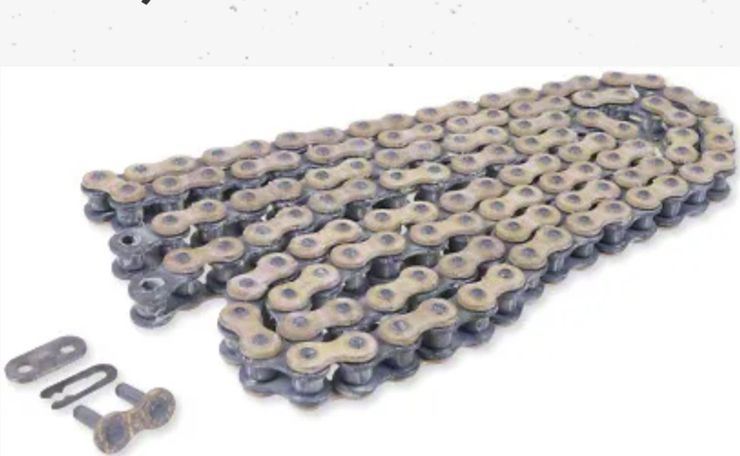
Check the condition of the chain. If the chain is stretched, you will find this out in the following way. Place the bike on the center stand. Pull the chain up the middle of the rear sprocket. If more than 50% of the teeth on the sprocket are visible, it must be replaced.
When does the drive package need to be replaced? It is recommended that the entire drivetrain be replaced even if only one of the three components (front sprocket, chain and rear sprocket) is worn. The reason is that if only one of the three is worn, this will cause rapid wear on the other two. For example, a worn chain will quickly "eat up" both sprockets.
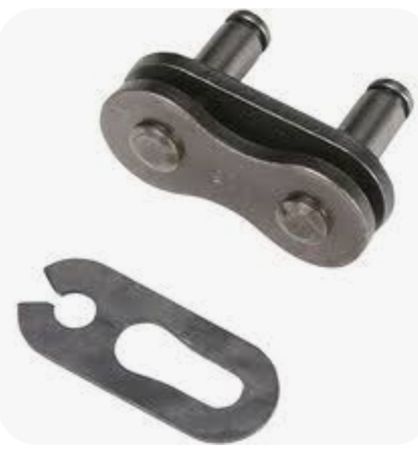
Correct installation of the chain lock. If you have a chain with a chain lock, remember to mount the lock so that the opening on the lock clip points backwards, i.e. opposite to the direction of travel of the chain. Remember to check that the rear wheel is mounted correctly, and that it does not point to the right or left in the longitudinal axis. A "crooked" rear wheel increases wear on the drive package.