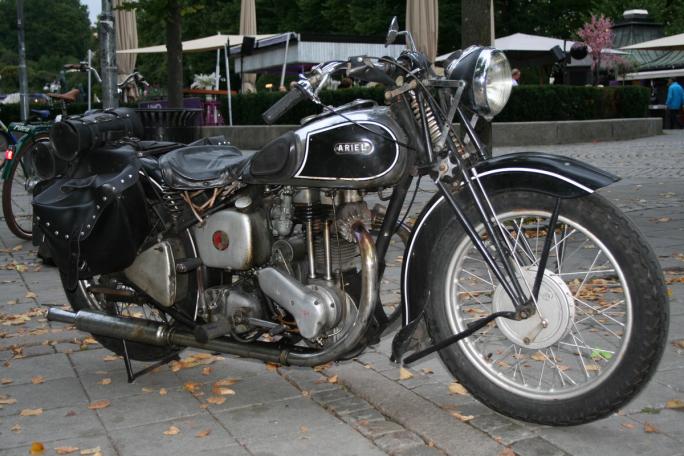
"I've driven Moss-Inderøy round trip, and it's 150 kilometers"
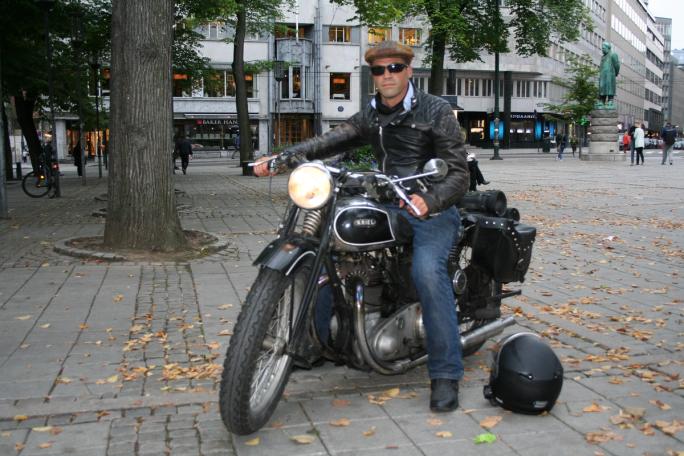
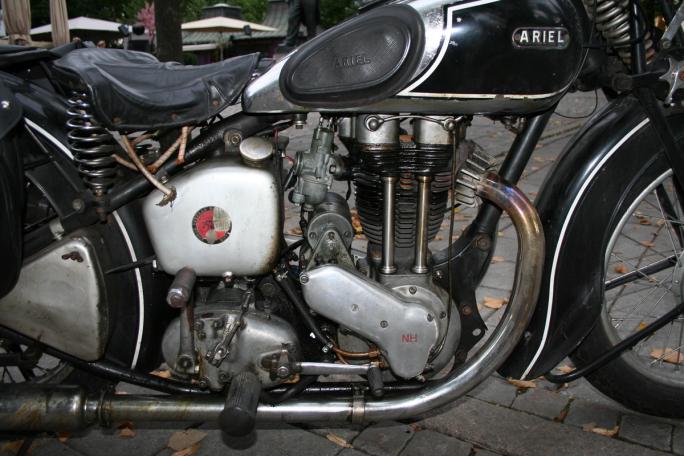
Tor Boye Okkenhaug's Ariel , a VG500 De-Luxe from 1932, is used as often as he can, and the engine, which is a 2-port 500 that produces 25 hp at 6000 rpm, does the job, even on the highway. The cylinder is almost square, so the rev-friendly engine gives the bike a top speed of over 140 km/h. Tor has, among other things, ridden from Moss up to Inderøy and back, a distance of 150 miles.
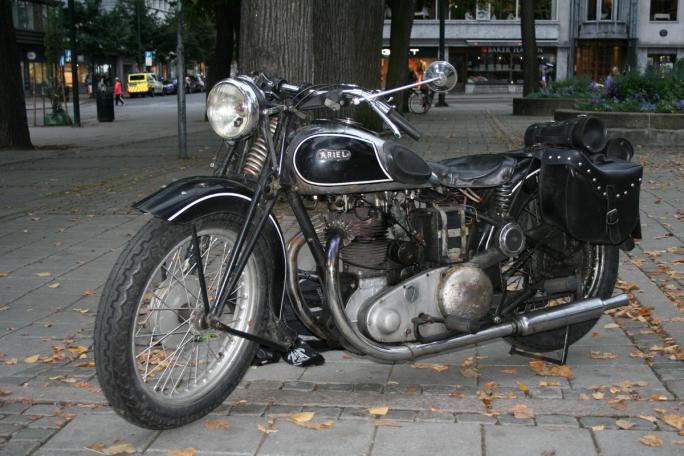
Ariel Motorcycles traces its roots back to 1870 when James Starley and William Hillman established a small business making spoked wheels. The motorcycle production was founded as early as 1902 in Bournbrook, Birmingham. Ariel was long one of the leading British motorcycle manufacturers, and is known for the spectacular model "Sqaure Four", a four-cylinder 4-stroke.
1902
The first motorcycle to have Ariel emblem on the fuel tank was made in 1902, and was a small 2-stroke with an engine from Kerry. This was modern for its time with, among other things, magneto ignition and a carburetor with a float. In the same year, Jack Sangster came in as owner with the company Components Ltd. Under Sangster's management, Ariel developed a number of prominent models. Ariel also made cars in the period 1902-1925.
Edward Turner and Val Page
Other key figures in the English motorcycle industry who were associated with Ariel were Edward Turner and Val Page, and together these three would help to lift Ariel to the top. The centre of gravity of the English motorcycle industry was in Birmingham, and the city was for a long time the "motorcycle capital". In 1936 Sangster bought Triumph , and the company continued to grow. In addition to the bike we will be discussing in this report, we cannot avoid mentioning Ariel's, and perhaps the most spectacular motorcycle of the time, the Square Four. This had a four-cylinder four-stroke engine, where the pistons were placed in a "square". The design can be attributed to Edward Turner, and he is said to have drawn it in a pub cellar sometime in the 20s, way down in the second pint of brew! Among Ariel's bestsellers we find the model "Red Hunter". In 1951 Sangster sold Ariel and Triumph to BSA , which thus became the world's largest motorcycle manufacturer. Production of Ariel motorcycles with large 4-stroke engines ended in 1959, and the years leading up to the closure in 1967 were characterized by the scooter-like 2-wheelers "Arrow" and "Leader".
Troubled ignition
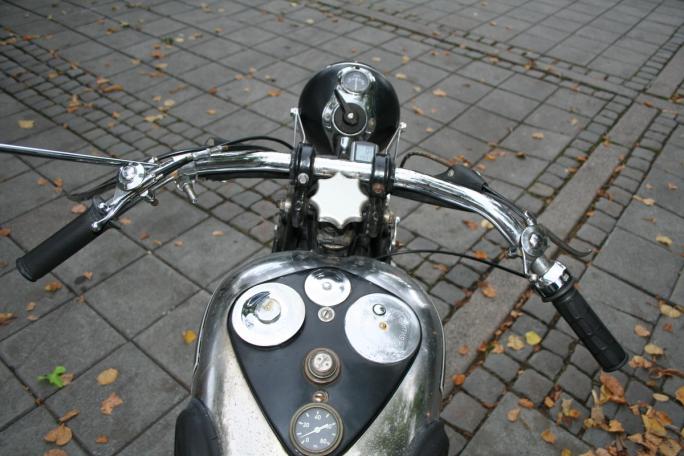
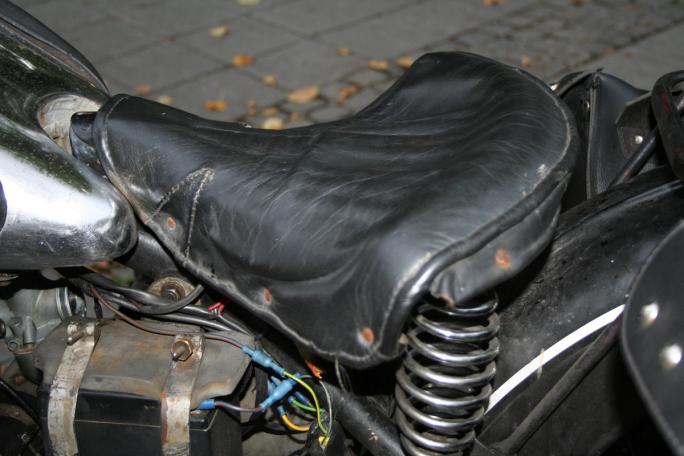
Tor Boye Okkenhaug from Moss bought his Ariel unseen from Nord-Trøndelag in 1999. This is a 1-cylinder 500cc with the model designation VG500 De-Luxe. The De-Luxe distinguishes it from other similar models in that it has its own and "comprehensive" instrument panel on the gas tank. The bike, which is completely original, was well used when Tor got it, and as he got to use it, it turned out that it needed some maintenance. Tor says that the first three years were quite a headache. The magnet was very unstable, and even though it was repaired repeatedly, the bike was not completely reliable. He ended up putting it away in the garage, where it was left to rest until 2012. By then Tor had regained his motivation, and together with his neighbor they set about working on the electrical system. After some trial and error, with burnt pins etc., the magnet was replaced in favor of an electronic ignition system. This is camouflaged inside the old one, and is practically invisible, but functional. The bike now became much more reliable, and inspired by the progress, Tor contacted Brødrene Lihaug Motorverksted in Larvik.
Technical upgrade
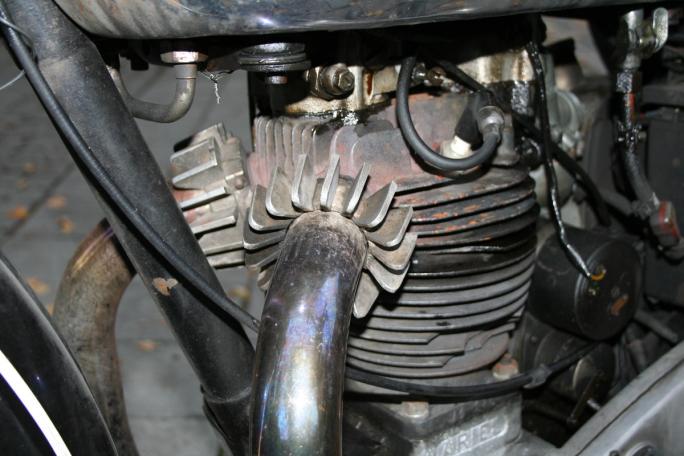
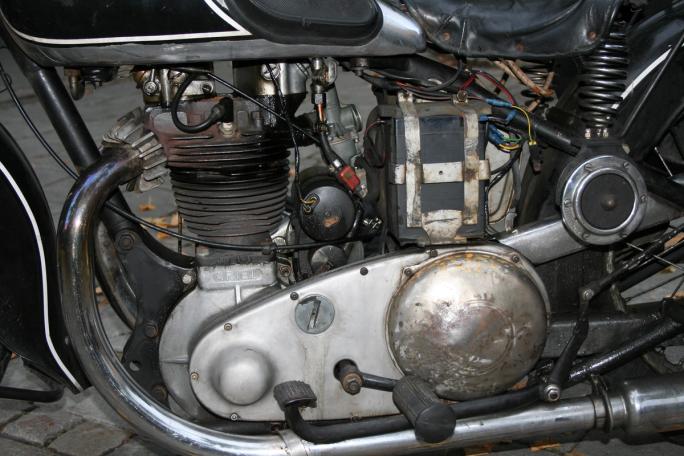
He now wanted assistance in order to upgrade the Ariel technically. He wanted to keep the original patina. With the good help of the company in Larvik, Tor had the bike picked up. A combination of lack of lubrication, worn bearings, worn primary chain, bad cylinder head and of course a portion of oil leaks, made it necessary to have an extensive technical renovation of the engine. A new and unused top was installed, as well as a new crankcase. The primary drive was also improved, and now the primary chain runs in line between the engine drive and the clutch drive, and the clutch works well. What remains now is the gearbox. Tor says that it has a tendency to slip at maximum torque, so the "box" will be overhauled in the winter.
Moss-Inderøy round trip
Not everyone uses their vintage motorcycle the way Tor does, and he has, among other things, ridden the Moss-Inderøy route round trip, a 150-mile trip. For Tor, this particular trip was a dream come true, as he adds: "It's really good with an 84-year-old motorcycle!" He uses the Ariel as often as possible, and when he parks he meets many motorcyclists who take the opportunity to take a look at the patinated "Englishman". Many are speechless when he tells them that it is from 1932.
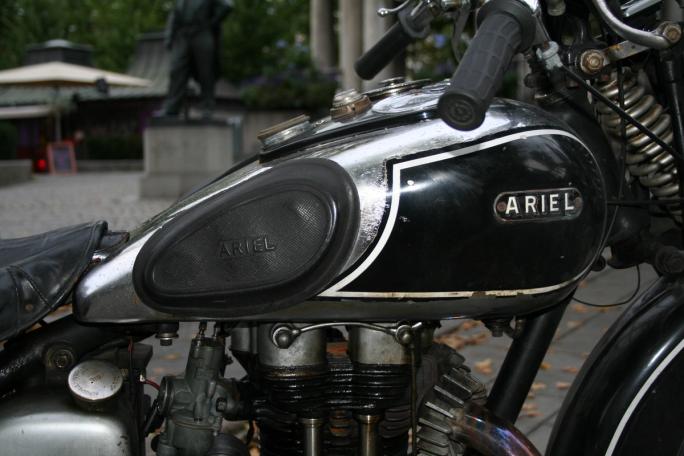
Finely patinated
Tor has considered whether he should "shine" up the Ariel purely cosmetically, with new paint, chrome, etc., but it has now been decided. As he says, "It has never been restored, only repaired and fixed up over time. The gas tank is a little rusty, but everyone, including myself, thinks it has an incredibly nice patina, so in terms of appearance it is finished." We agree. Patinated and original vintage motorcycles are living motorcycle history on wheels.