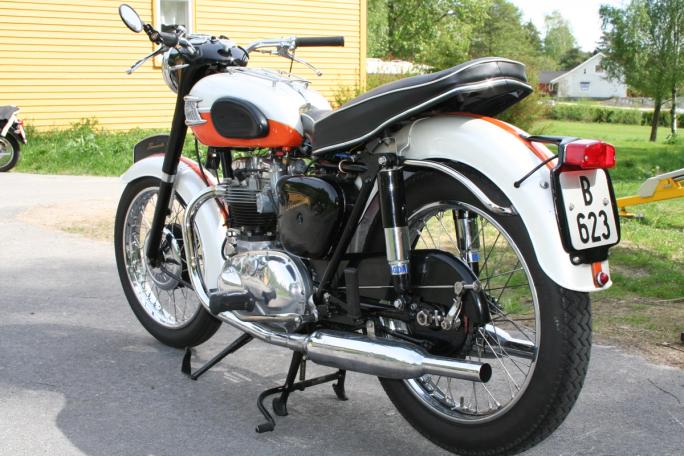
Triumph Bonneville 650 T-120
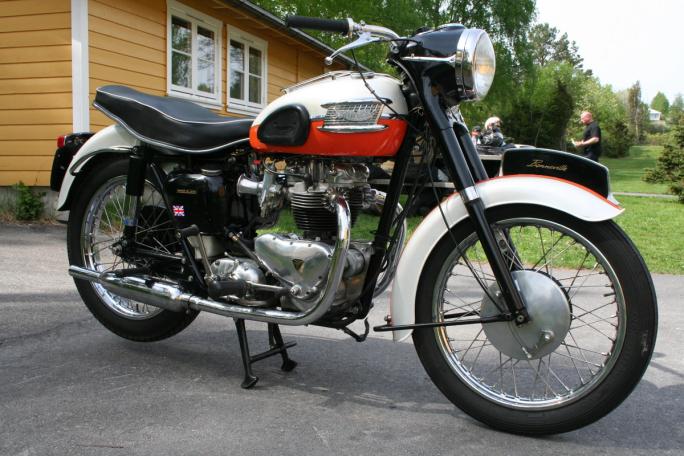
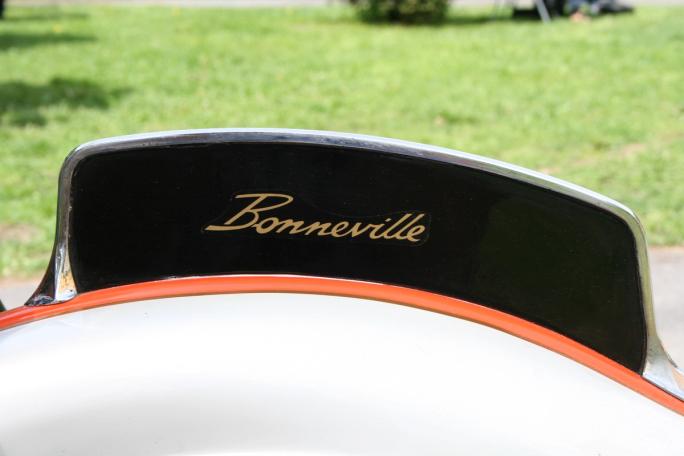
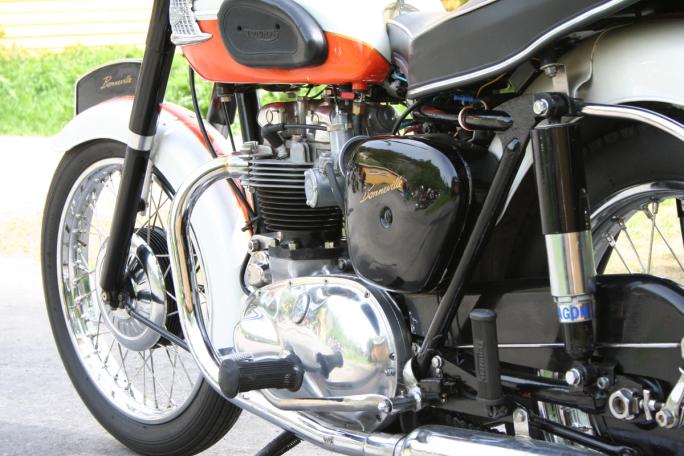
Triumph's trendsetter, Bonneville T-120, was launched in 1959, and with the sportiest and fastest twin in Triumph's history, they took America by storm. Bonneville , named after the legendary record-breaking race at Bonneville Salt Flats in 1956, became the motorcycle that set a new standard for design and performance. Bonneville became an icon, and a symbol of youthful brutality. I've dug a little into the history behind the sports bike with the legendary name, and which is considered the crowning achievement of Mr. Triumph himself, Edward Turner.
The story behind the Bonneville actually began in the 1930s, with the division of Triumph Motor Company Ltd. In 1936 it was decided that Triumph 's car and motorcycle production would be separated into two independent companies. The MC production was handled by the newly formed company " Triumph Engineering Company". The new establishment was handled by motorcycle legend Jack Sangster, and the head of the new company was none other than the legend Edward Turner. The new factory for the production of motorcycles was built in Meriden, halfway between Coventry and Birmingham.
The eccentric Turner
Mr Turner was no novice when it came to motorcycle construction. He was, among other things, the man behind Ariel's spectacular Square Four. Eventually, other well-known motorcycle personalities joined the team, including Herbert Hopwood and Doug Hele. Together they would create one of the most legendary motorcycles of all time, Triumph Bonneville . Hopwood is also a very interesting person, for those who want to delve into the English motorcycle industry and why it went under. In his memoirs "What ever happened to the British motorcycle industry", the reader gets a solid insight behind the facade. Hopwood's relationship with Turner is also described, and there is no doubt that Turner was perceived as an eccentric who could at times be very difficult to work with. Perhaps not so strange considering that Turner referred to himself as Mr. Triumph on several occasions!
The trendsetter Speed Twin 500
The year after he took over, the motorcycle that would become a trendsetter for all English brands was released, Triumph Speed Twin . The model became very popular, largely thanks to the twin-cylinder power package of 498 cc and 26 hp. This gave a top speed of 151 km/h, which was very high for a standard machine in 1937. The new twin design would become Triumph's trademark for more than 50 years.
Tiger 100
As early as 1939, a new twin model came from the factory in Meriden. This sporty model was named the “ Tiger 100”. The price tag in England was 75 pounds, and for this the customer received a motorcycle that was “Fully equipped with Lucas magdyno lightning and electric horn”. Mr Turner had met expectations, and he had several models on the drawing board. The American market would eventually become very important for Triumph . Turner was aware of the sales potential on the other side of the Atlantic. When he signed the contract with Sangster in 1936, it contained, among other things, a clause that ensured Turner a 6-month stay in the USA every year. This allowed him to build up a solid network of dealers on both the East and West Coasts.
Marlon Brando's " Thunderbird "
Triumph's popularity was rapidly increasing in the United States after World War II, and the rebels' first choice was Triumph . The sporty look of the brand from Meriden had a strong appeal to the leather-clad rockers. Triumph's popularity rose to new heights when Marlon Brando came sweeping on a Thunderbird 650 in the film "The Wild One" in 1954.
1956: "World Speed Record holder"
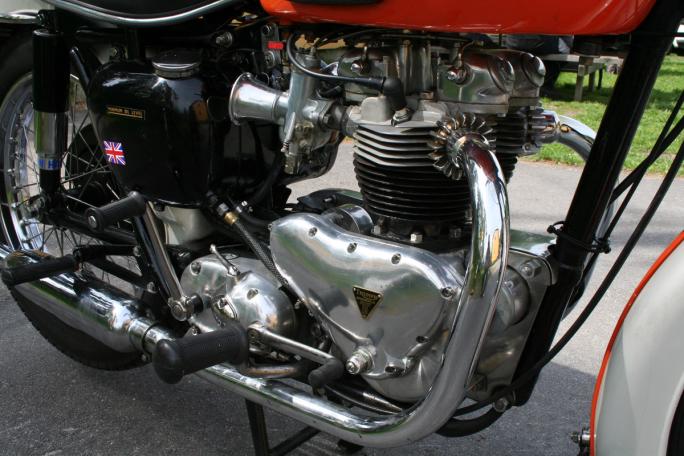
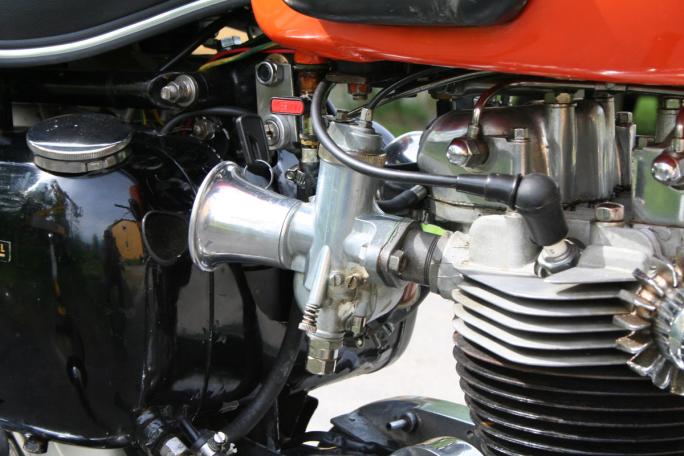
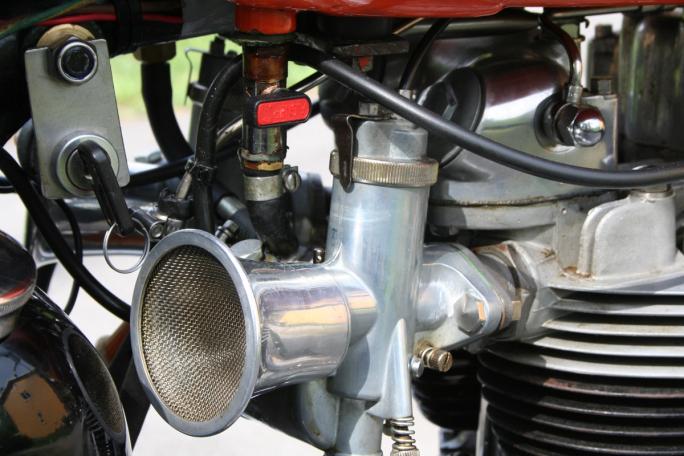
Turner eventually spent a lot of time on the race tracks in the USA, where various racing models from Triumph were tested. It was also on this continent that Triumph would write its name into the history books. American Johnny Allen's record run at Bonneville Salt Flats in Utah, on Thursday 6 September 1956, was a sensation. Allen's "Streamliner" was powered by a trimmed Triumph twin with 65 hp. The engine had a number of goodies under the cylinder head, which was also equipped with two carburetors (the cylinder head with the two carburetors would become Triumph Bonneville's most central characteristic). When the cigar-shaped device passed the measuring point, the needle showed a whopping 214.4 mph, which is equivalent to 345.08 km/h. The event in Utah would later give the name to one of the most popular and spectacular models from Triumph , more specifically Bonneville T-120.
Triumph vs Harley Davidson
At the beginning of 1958, the order books for Triumph factory in Meriden were well filled. Tiger , Thunderbird and Speed Twin sold well, but in the development department there were several people who wanted a faster and sportier model. Indications from the dealer network in the USA indicated that the market was ready for a fast roadster. These indications were based on the fact that in America there were a number of small companies that supplied trim kits for Triumph , which gave the English twin extra push. From 1957, Triumph had competition from Harley. This year, the factory in Milwaukee launched its new sports model " Sportster " with 883 cc. The Sportster quickly became popular among "rockers and rebels", a group that had been loyal customers of Triumph . However, the boss himself, Mr. Turner, was not convinced that a new model was needed. A tug-of-war gradually developed between the various departments in Meriden, supplemented by both opinions and visits from the importer in America.
Road and race
In the USA, suppliers of “aftermarket kits” had created a number of parts that promoted the power and performance of Triumph models. At the same time, interest in track racing was growing in England, and every serious motorcycle manufacturer with self-respect was aiming for a podium finish and the most prestigious trophy. Triumph was no exception, and the brand took a number of top positions on the various tracks. This was undeniably good marketing, something that Mr. Turner could not help but agree with. Edward Turner’s skepticism about the idea of a Sportster version with two carburetors gradually disappeared, despite the fact that the prototypes kept breaking down during test runs. The tried and tested 650 cc parallel twin showed clear weaknesses when it was given an extra carburetor. The problem lay in the crank section, which could not handle the extra horsepower. However, the engineers in Meriden solved the crank problem and other unforeseen surprises. Late in the fall of 1958, Turner advocated for more targeted and systematic development work, and the new model gradually took shape.
Two carburetors
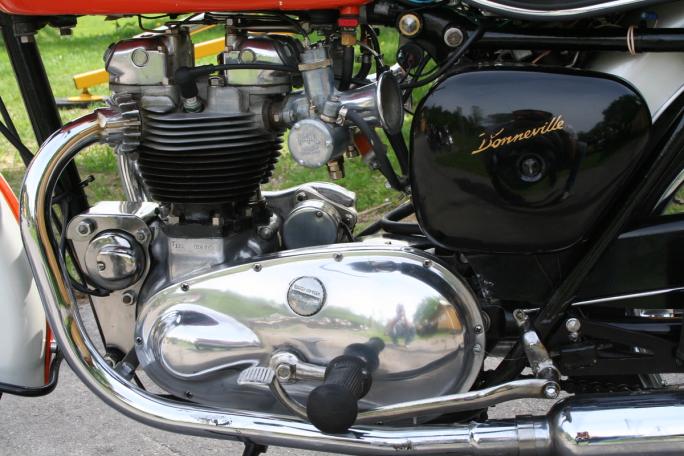
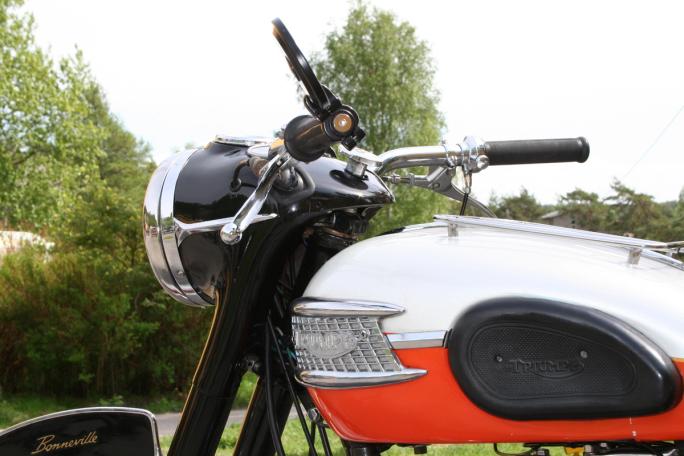
Since most of Triumph's "Big Twins" used interchangeable parts, it was not always easy to tell whether the bike parked on the street corner was a Tiger , a Speed Twin or a Thunderbird . However, the new model had to stand out clearly from its model brothers. This was done by giving the bike a sporty look, where the color combination and last but not least a twin engine with two carburetors, just like on Allen's record machine. The Bonneville was shown in the autumn of 1959, and took the public and press by storm. The soft lines and the sporty thrust, well emphasized by a twin that delivered a whopping 46 hp at 6500 rpm placed Bonneville in the top tier. The legend was a fact and Bonneville became Triumph's top model until the last bike rolled off the assembly line in the Meriden factory in 1983. An era in the English motorcycle industry was over.
Key developments in the history of the Bonneville:
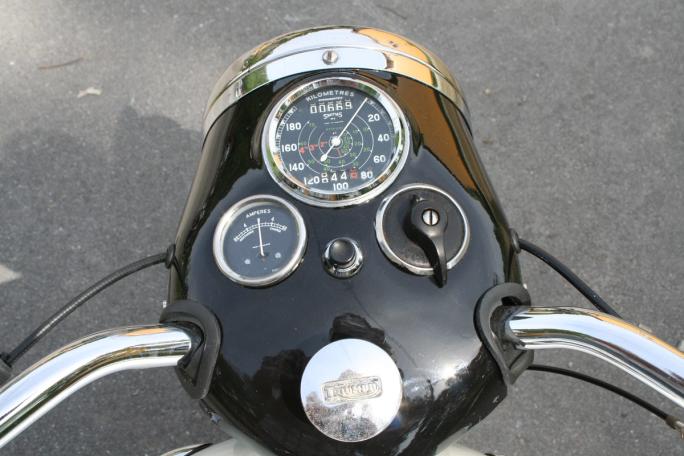
- 1960: The nacelle lamp on Bonneville is changed to a conventional lamp
- 1963: The Unit engine is put into service
- 1966: Bonneville gets 12-volt electrical system
- 1971: 5-speed gearbox for the US models, and new "oil in frame" frame.
- 1973: 750 engine and front disc brake
- 1980: Electric start
- 1983: The last Bonneville is built at Triumph factory in Meriden.
- 1988: The very last Bonneville is assembled from new parts, under license by Les Harris in Devon.
Technical data Triumph Bonneville T-120, 1959 model
Engine: 2-cylinder parallel twin, OHV
Displacement: 649 cc
Power: 46 hp at 6500 rpm.
No. of gears: 4
Weight: 183 kg
Top speed: 192 km/h