
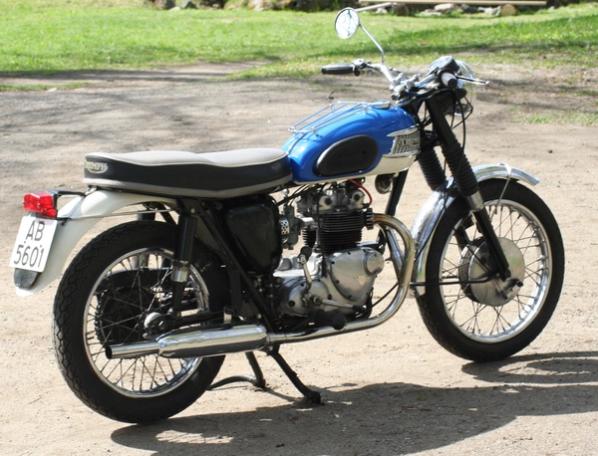
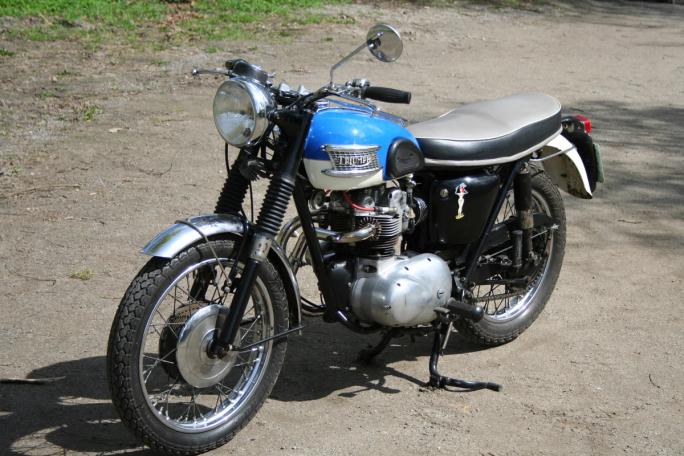
Triumph 350 3TA
In the years after World War II, smaller motorcycles provided the daily transportation needs of the "man in the street." Motorcycles with a displacement of 350 cc were more than big enough for many, and one of these was Triumph's commuter bike "Twenty One," whose model designation referred to the bike's displacement in cubic inches.
With the introduction of Speed Twin 500 in 1937, Triumph set the standard in both design and performance. The new twin heralded a new era, with more power and higher top speed. Speed Twin became the “blueprint” for almost all of the English motorcycle manufacturers, and the “brains” behind its design, Edward Turner, could look forward to a brilliant career. The new twin was well received, but World War II put an end to much of the product development.
Triumph Twenty One
After peace was a fact and Europe gradually rose from its knees and straightened its back, the need for transport became enormous. The old settlement pattern from before the war gradually changed in step with large-scale industrialization, and gradual urbanization led to a great need for transport. The motorcycle became the solution for many. Triumph quickly realized that there was a great demand for affordable motorcycles, and began development work on a smaller and lighter model.
The two models Speed Twin 5T and Tiger 100, both 500cc, were relatively expensive, and a model in the lighter segment was considered commercially interesting. The result of this work was the 350cc Twenty One, which went into production in 1946. This was confusingly similar to Speed Twin 5T, only smaller in displacement and external dimensions. That Triumph actually copied Speed Twin 5T is no surprise when we know what a success it was when it went on sale in 1938. The Twenty One was well received, and was produced until the mid-1960s. The 350cc had its strength in that it was light and easy to ride, and it became a success as a daily means of transportation, or so-called "commuter bike".
From Twenty One to 3TA
In 1958, it changed its name from "Twenty One" to 3TA. The most extensive development of the model was the swingarm at the rear that came in 1953, the unit engine that came as early as 1959, and the "Bathtub version" that came in the 60s. The covered rear of the motorcycle gave it a very special look, and it was rightly nicknamed "the bathtub". Towards the mid-1960s, the market for the smaller machines disappeared. Increased purchasing power made the car more accessible at the same time that the motorcycle market focused on larger, stronger and faster motorcycles. Thus, the basis for the smaller motorcycles disappeared.
Technical data: Triumph 350 3TA, 1965 model
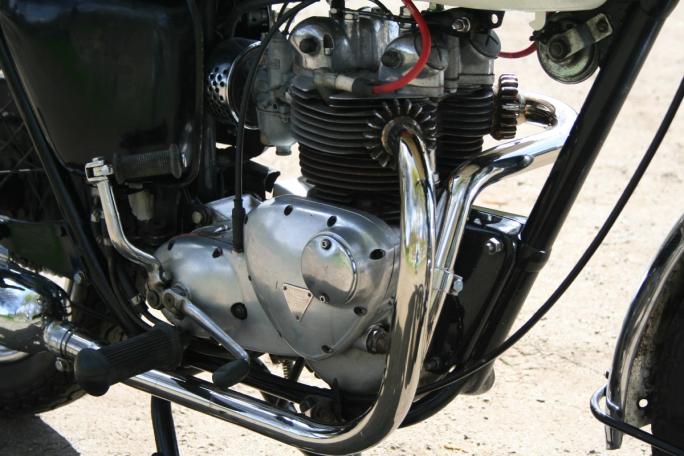
Engine: 2-cylinder 4-stroke, OHV
Displacement: 348 cc
Power: 18.5 hp at 6500 rpm.
No. of gears: 4
Electrical system: 6 volts
Front tires: 3.25 x 18
Rear tires: 3.25 x 18
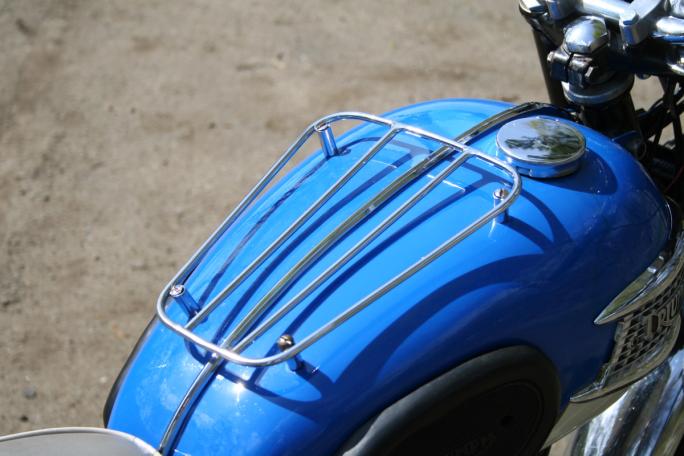
Tank: 16 liters
Weight: 154 kg (dry)
Top speed: 128 km/h