
Suzuki GT750
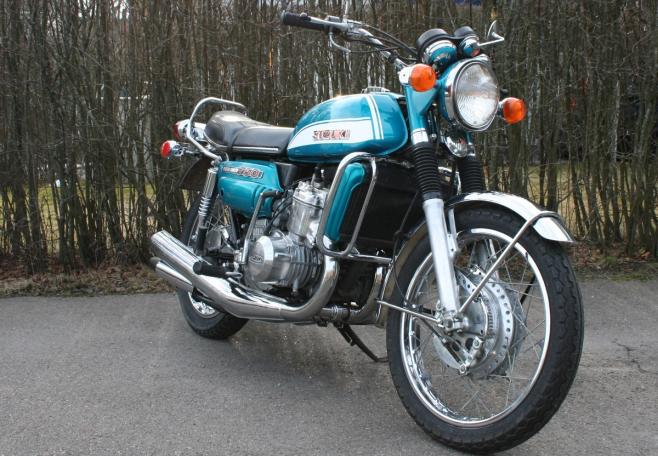
Japan and the USA got the GT750R as early as 1971. In 1972 it came to Europe, then as the GT750J.
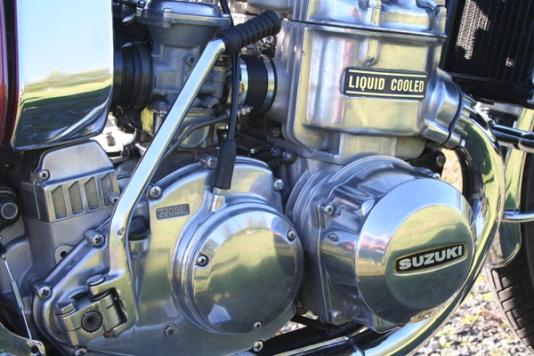
A beloved child has many names, and when the "Water Bus" went on sale in 1971 it became a cherished possession for many die-hard Suzuki fans, but only the Japanese domestic market and the USA had access to the 3-cylinder water-cooled 2-stroke in its first year of production. The rest of the world didn't get access to "The Kettle" until 1972. They say that all good things come in 3's. For Suzuki , the GT750 became just that.
0/0
In many ways, it was Honda that started the superbike circus with its inline-four CB750Four. It was solemnly unveiled to the public in October 1968 at the Tokyo Motor Show, and set a completely new standard for 4-strokes in the 750 class. Norton Commando 750 had "only" 2 cylinders, and the most real competitors of the time were the triples BSA Rocket III and Triumph Trident . The other Japanese manufacturers mainly dealt with 2-strokes, unaware that OPEC's plans to reduce world oil production were just around the corner, which was the first nail in the coffin of 2-strokes.
From 2-stroke twin to 2-stroke triple
By the end of the 1960s, Suzuki had established a good position in the international motorcycle market, and the 2-stroke T-500 with its 50 hp offered exciting experiences with strong acceleration. The model was known for its quality and, by the standards of the time, quite good handling. However, the CB750 from Honda could not be ignored, and many now chose the 750 cc instead of the largest and thirstiest 2-strokes, which Suzuki also noticed. Thus, the time had come for development work at Suzuki , the T-500 was no longer enough to stem the leakage of customers to Honda . A competitor to the CB750 had to be in place as quickly as possible.
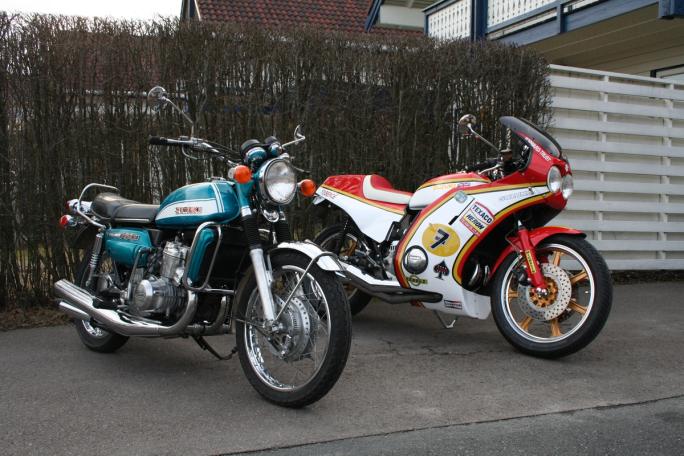
Original and rebuilt
Tokyo Motor Show October 1970
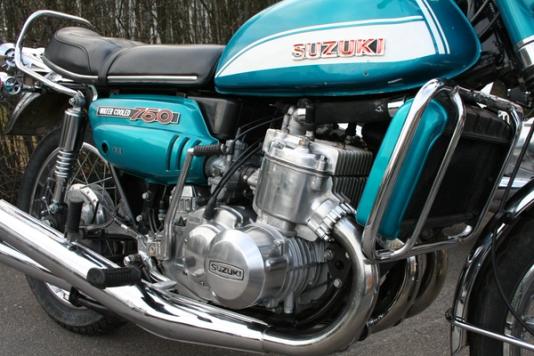
The solution that Suzuki landed on was in no way dissimilar to the one Triumph chose when they developed the Trident T-150 triple; they took the engine block of the 2-cylinder 500cc engine and added an extra cylinder. Suzuki did essentially the same with their T-500, they added an extra cylinder, rigged it for water cooling, and voila, the GT750 prototype was on display at the Tokyo Motor Show in October 1970. Suzuki was now ready to measure power with Honda's super fours. And, let it be said right away; the 3-cylinder 2-stroke could produce power and torque on par with the Honda, which put an end to the myth that 2-strokes couldn't deliver Newton metres.
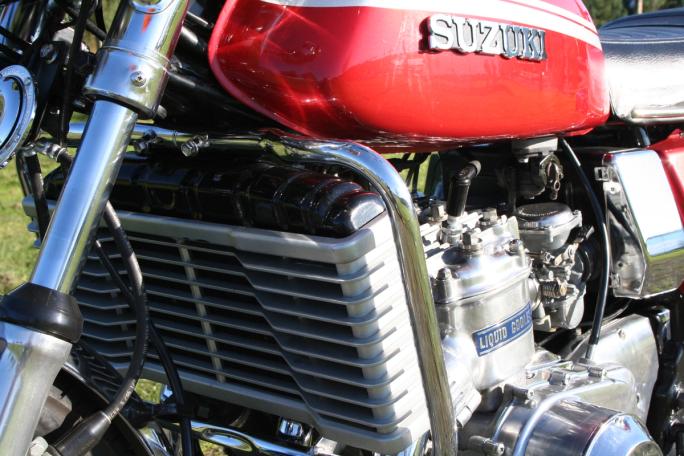
The large radiator with thermostatically controlled fan contributed to efficient engine cooling
The ultra-rare 1971 model; GT750R LeMans
For collectors, the 1971 GT750R is "highly sought after" as they say in England. They didn't get "The Kettle" until 1972, which was also the case for the European market. The 1971 model was only sold in Japan and the USA that year, and in the USA it was given the pretentious model name 750 Le Mans, and sold through Kawasaki's dealer network. The 1971 model is recognizable by the wide stripe along the bottom of the fuel tank, and the exhaust system without equalizer pipes. Apart from this, it is almost identical to the 1972 model. Both years had the characteristic double-acting drum brake at the front, as well as the conical steel nozzles at the end of the exhaust pipes.
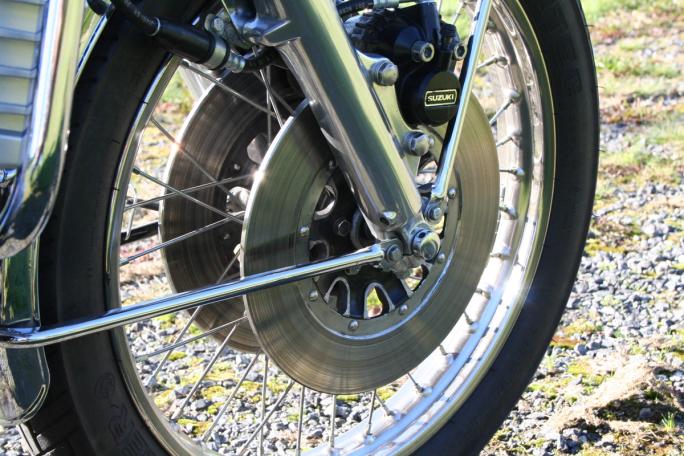
In 1973, the GT750 received dual front disc brakes
Technically advanced
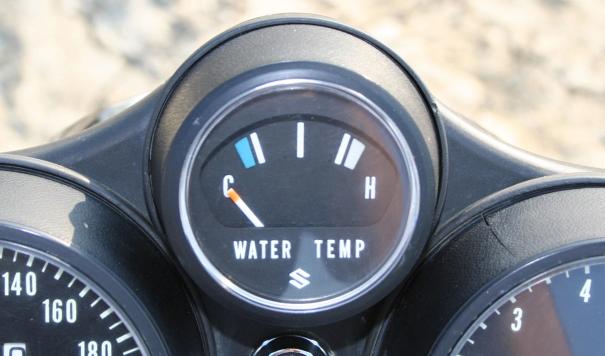
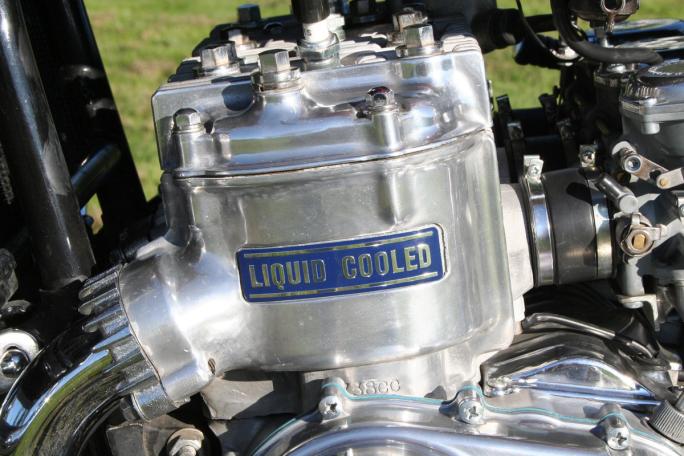
A 3-cylinder 2-stroke with liquid cooling and electric start was quite refined at the beginning of the 1970s, and many motorcycle models with a much lower degree of refinement have had their weaknesses and faults. What about the water bus? It was intact throughout. The engine's cylinder head gasket and cooling system worked perfectly. The thermostat opened at 82 degrees, and the water pump ensured effective circulation so that the coolant did an effective job of transporting the excess heat up to the radiator for necessary cooling. Suzuki did a thorough job of testing the prototype in the warm Pacific climate to really be on the safe side. If it could handle the heat there, it would do just fine in other climate zones, which it did.
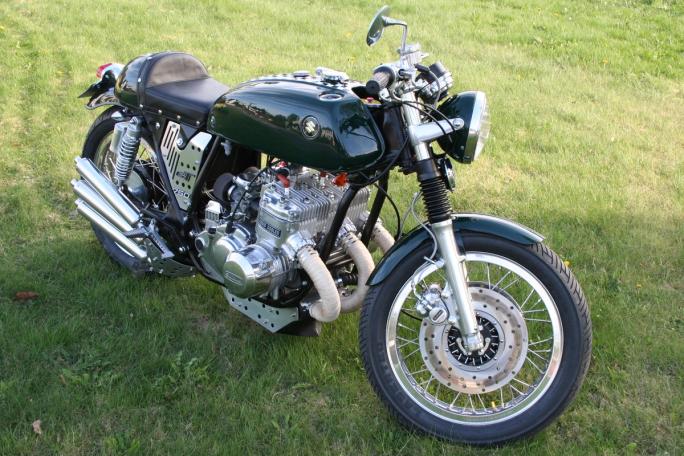
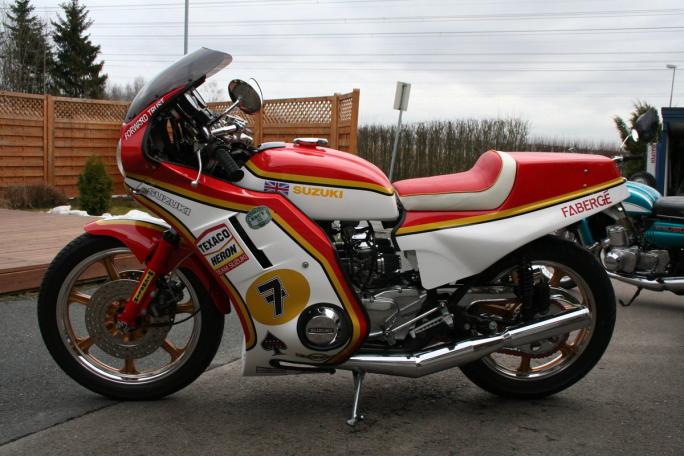
GT750 in "caferacer clothes".....
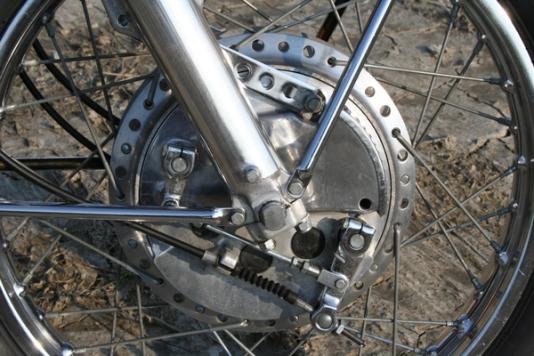
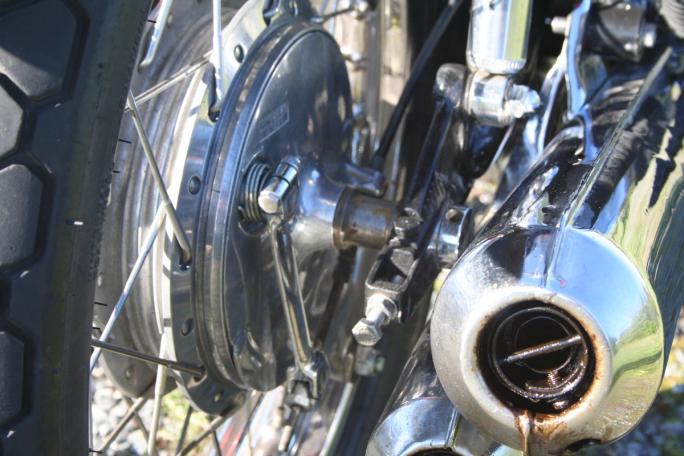
Double-acting drum brake
The noise that 2-strokes were known for was also reduced by the use of a cooling shroud around the engine. Driving characteristics are also something that owners are concerned about, and in this area it did not disappoint either. The double-acting drums at the front worked as effectively as a single disc brake, a solution that could be found on Honda CB750 and Kawasaki H2-750, and the double cradle frame was more than stiff enough in relation to the bike's performance. The top speed of the GT750 was estimated to be around 186 km/h. Looking back on the anniversary, we can safely say that the "Water Bus", or "The Kettle" or "Das Vasserbøffel" was a success for Suzuki , both on the road and on the racetracks. Of course, there was a successful road racing machine, the TR750 with the same engine, ridden by the legend Barry Sheene.
From 67 to 70 hp
The engine that was the basis of the GT750 changed very little during the years it was in production, with the exception of the power increase in 1975, when it was stated to be 70 hp. However, its exterior underwent constant changes. The Model J, which was produced in 1971 and 1972, was almost identical except for the stripes on the fuel tank and the equalization pipes on the exhaust system. In 1973, the Model K came with dual disc brakes at the front and with several parts in chrome finish. The Model L, which came in 1974, was the one that offered the most upgrades during the model's 7-year life, including a new exhaust system and new side covers.

Elegant and easily accessible coolant refill
1977; end of journey
The last GT750 model came in 1977 as the B model. This had the same fuel tank as Suzuki's new 4-stroke GS750. It is worth noting that the oil crisis that occurred just a couple of years after the water bus's debut did not in any way dampen the model's popularity, despite the 2-stroke's fuel consumption and emissions. It remained popular as Suzuki's heaviest, largest and strongest card in the fight for customers in the 750 class. Today, the GT750 is a sought-after veteran. If you are looking for an original "water bus", it is good to take a look at pictures of an original machine from the respective year that is desired, because parts are interchangeable on all seven model years, and there are items for sale out there that can be a bit "lobster & canary", i.e. put together from parts from different years.
Color codes:
-1971/1972: Candy Lavender, Candy Yellow Ochre, Candy Jackal Blue
-1973: Blue/White, Gold
-1974: Flake Orange, Flash Blue
-1975: Jewel Gray Metallic, Candy Gipsy Red, Candy Gold
-1976: Maui Blue Metallic, Flake Orange
-1977: Red, Blue, Black
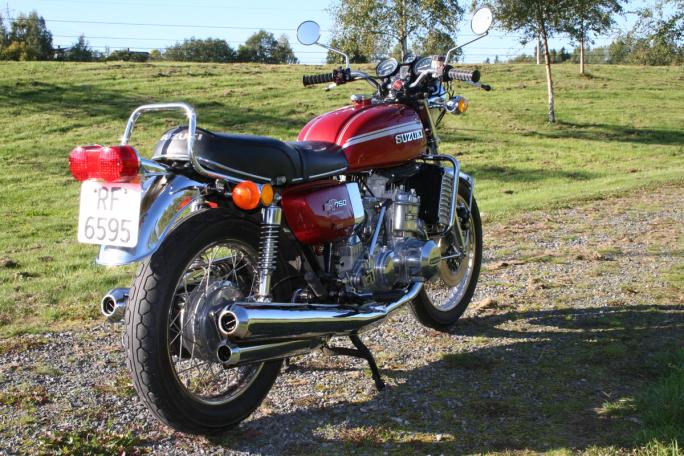
In 1974, the GT750 received a new design, including the exhaust pipes and side covers.
Technical data Suzuki GT750R, 1971 model:
Engine: 3-cylinder 2-stroke with water cooling
Bore x stroke: 70 x 64 mm
Displacement: 738 ccm
Power: 67 hp at 6500 rpm.
Compression: 6.7:1
Carburettors: 3 x Mikuni 32 mm
No. of gears: 5
Front brakes: double-acting drum
Rear brakes: drum
Front tires: 3.25x19
Rear tires: 4.00x18
Tank: 17 liters
Weight: 214 kg (dry)
Top speed: 186 km/h
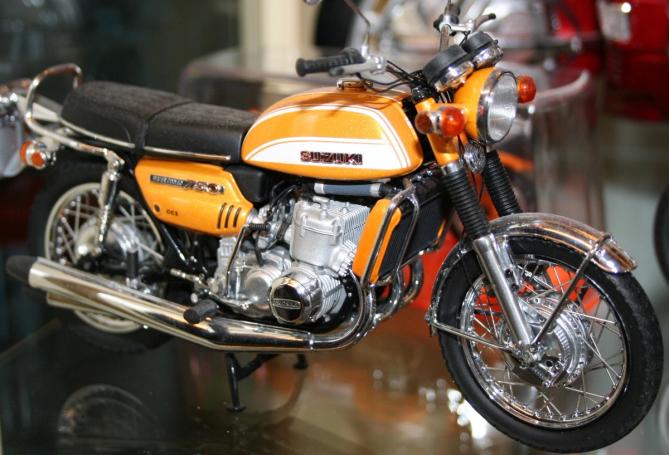
Candy Yellow Ocher suits the GT750 well