
Honda CB1100R
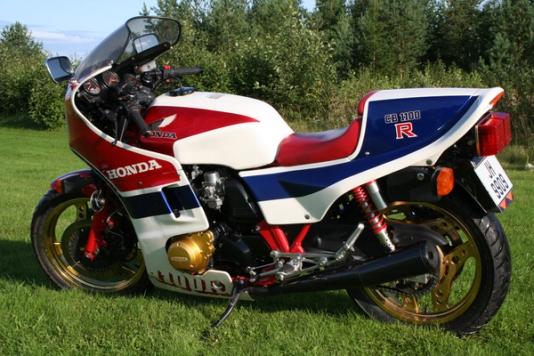
When Honda launched its new sports machine CB 1100R in 1981, the bike that is considered the first modern R-machine was born. Many would argue that Suzuki GSX-R 750 from 1985 was the first to meet the R criteria, but is this true? The story behind Honda's first modern superbike actually begins in 1976. That year, Honda took home victory in the legendary 24-hour Bol d'Or race at the Paul Ricard circuit in France, and Honda repeated the feat in both 1977 and 1978. Such success could not go unnoticed, and a model adapted for street use was bound to follow.
0/0
When Honda launched the CB 900F in the fall of 1978, they introduced the second generation inline-four engine with double overhead cams, electronic ignition and 4-valve technology. A new, more streamlined design with a fastback emphasized the bike's sporty character. Honda CB 900F proved to be very potent with its 95 hp, and the top speed reached 214 km/h. This gave the model a huge lead over its competitors, Kawasaki Z-1000 and Suzuki GS-1000.
The legacy of the CB750Four
The CB 900F was largely a product that sprang from Honda's successful racing model RCB. The RCB was initially built on the old single-cam engine CB 750, but with a significantly larger displacement and double overhead camshafts. Honda also took a surprising 1st place in the "Daytona 200" in 1970. With Dick Mann in the saddle, the 200-mile race was completed at an average speed of 165 km/h. The RCB model that Honda now used as its sharpest weapon in racing would prove to be almost unbeatable. When Honda took 1st place at Le Mans in 1976 with Alex George and Jean Claude Chemarin in the saddle, Honda was able to set another record. During the 24-hour race, the Honda passed the legendary 300-mile mark, and when the race was over, George and Chemarin had achieved a mileage of exactly 323.5 miles.
Bol d'Or
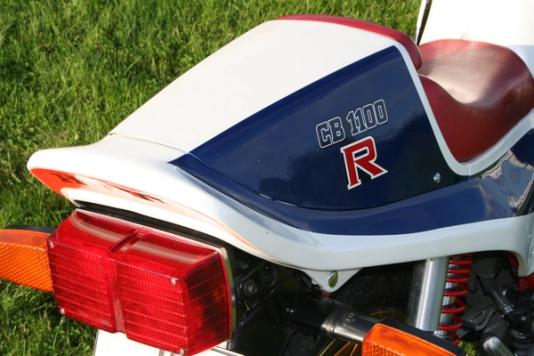
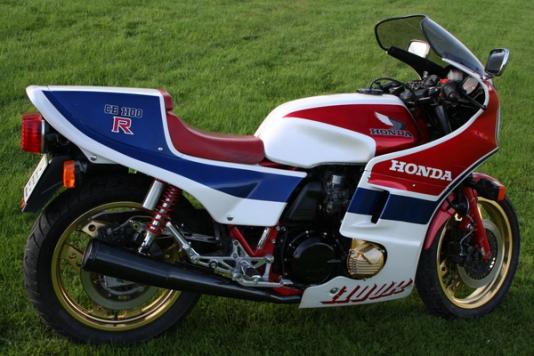
Honda soon built a number of examples intended for endurance racing. The most legendary race is probably the 24-hour race at Le Mans, and the Bol d`Or race at the “Paul Ricard Circuit” in France. Honda won in France and the factory took advantage of the success and attention, giving the new 900cc model the model name “Bol d`Or”. Honda was aware of the publicity that a victory in endurance racing meant for sales statistics. It was therefore decided to build a large and powerful sports machine purely for endurance, which could also be ridden on the street. The year is 1981, four years before Suzuki GSX-R 750, and the first R machine, Honda CB 1100R, is ready for sale.
140mph
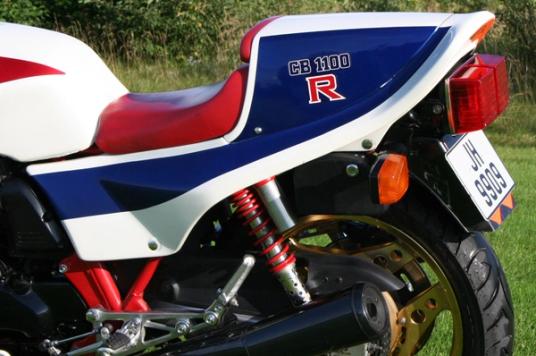
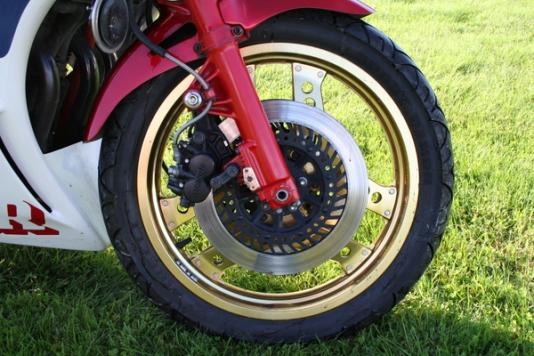
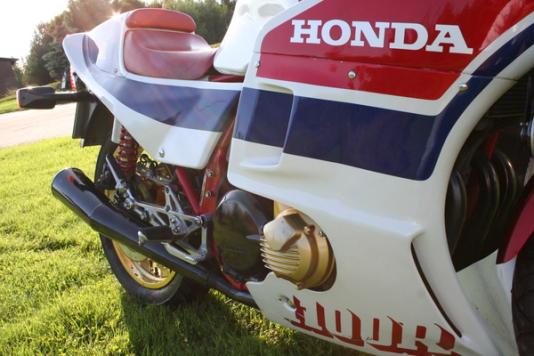
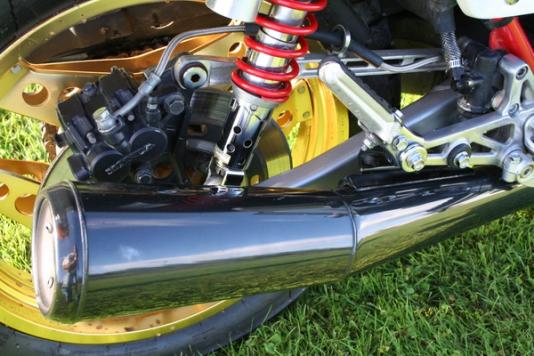
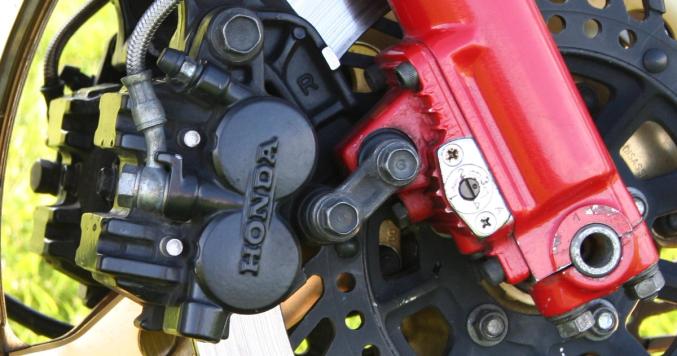
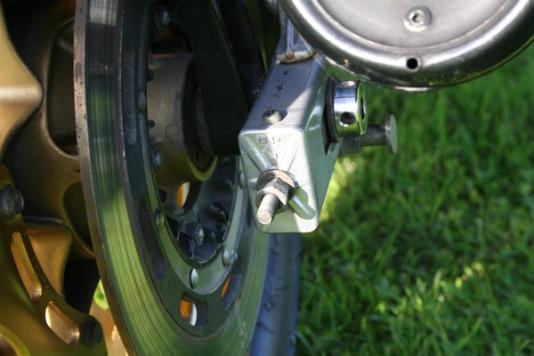
Based on the CB 900F, Honda began development work on the CB 1100R. A completely new and reinforced frame was built. The wheels were equipped with ventilated disc brakes with two pistons in each caliper, and a new and stronger front fork was installed. The fork also had "anti-dive", a sensible detail for hard braking. At the rear, a swingarm made of square-profiled tubing was installed, as well as gas shock absorbers that had adjustable pre- and post-tensioning. This allowed owners to make their own individual adjustments, depending on riding style and needs. The old CB 900 engine was modified and the block was bored out to 1062 cc. This gave an output of a full 115 hp (120 hp in the 1983 model) as opposed to 95 hp in the original 900 block. These 20/25 extra horsepower raised the top speed from 214 to a full 234 km/h. Honda thus easily broke the 140 mph limit, and chased the next milestone in terms of top speed for standard machines, namely the magical 150 mph limit!
Full-length coat from 1982
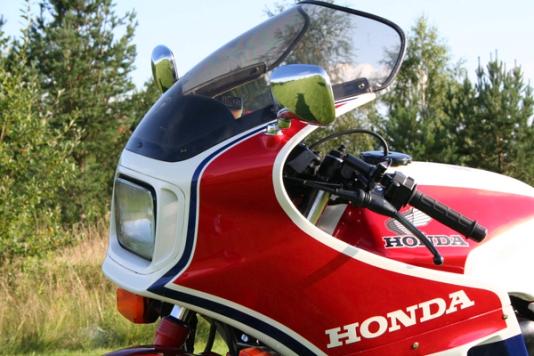
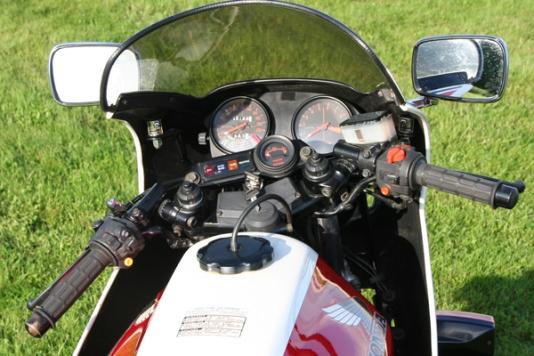
But, it wasn't just the extra power that gave the 1100cc bike good traction. The sporty full fairing (half fairing on the 1981 model) that came from the 1982 model onwards ensured reduced air resistance, and good protection for the rider at high speeds. Just right when the speedometer needle passed the 200 mark! With the CB 1100R as its sharpest weapon in the fight for the most prestigious trophies, Honda succeeded well. It took home a number of top positions from the racetracks both in the USA and Europe and not least in Australia. The CB1100R is today a highly regarded veteran, not least considering that only 4050 copies were produced.
Technical data: Honda CB 1100R, 1983 model
Engine: 4-cylinder 4-stroke, DOCH, 16-valve
Displacement: 1062 cc
Power: 120 HP
No. of gears: 5
Front tires: 110/90 x 18
Rear tires: 130/80 x 18
Front brakes: dual ventilated discs w. 2-piston calipers
Rear brakes: single disc
Weight: 235 kg
Top speed: 234 km/h