Harley-Davidson EL1000 Knucklehead
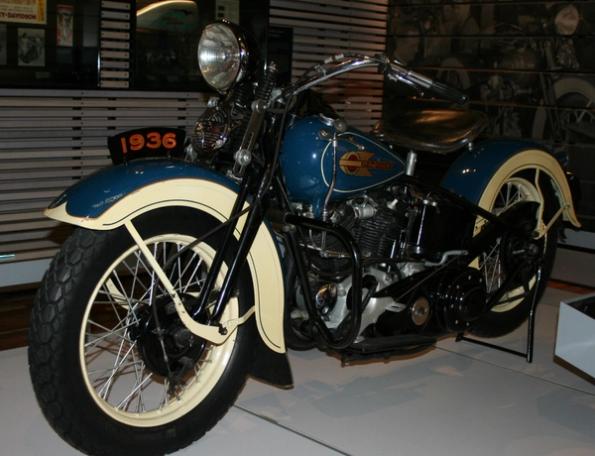
Despite the economic depression of the 1930s, Harley-Davidson management made plans for a new 1000cc motorcycle as early as 1931. The company gave itself 4 years to develop the new model, which was scheduled to be launched in 1935. When the model E61 went on sale in March 1936, Harley-Davidson could see a bright future ahead. The new big-twin was Harley-Davidson 's first mass-produced top-vented model, a concept that formed a line for Harley-Davidson from 1936 until the Evolution 1340 in 1984.
0/0
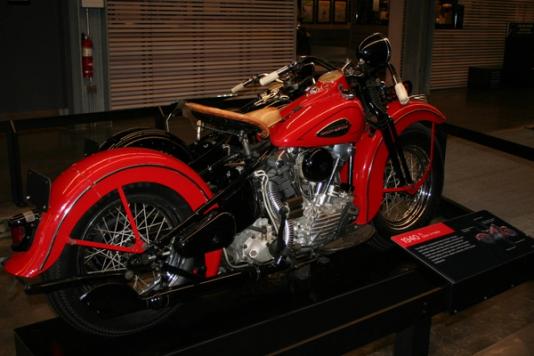
The new top-ventilated 1000cc model E with 37 hp, with the legendary nickname “Knucklehead”, became a very popular motorcycle. The big-twin lifted Harley-Davidson out of the economic depression and sales statistics to new heights. The model was the 3rd generation V-twin from Milwaukee, and eventually replaced the old Flathead series with side-ventilated engines.
The most beautiful motorcycle in the world
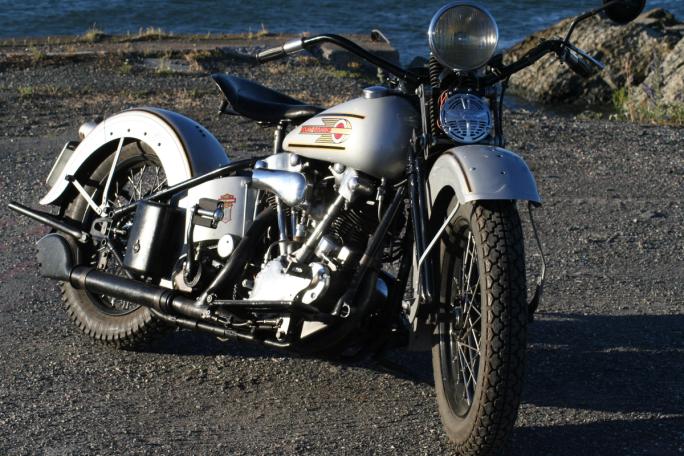
In its time, many people increasingly claimed that this was the world's most beautiful motorcycle. The low stance, the teardrop-shaped lines and the powerful V-twin at the center of the structure exuded power and elegance. Harley-Davidson was in many ways lucky with the timing when they introduced the new model. Development was underway when the depression was at its worst, and by the time the model was ready for sale, the dark clouds on the economic horizon were disappearing. The aftereffects of the stock market crash of 1929 had taken their toll on most American motorcycle manufacturers, leaving behind the two giants Indian and Harley-Davidson .
4 gears and dry sump lubrication
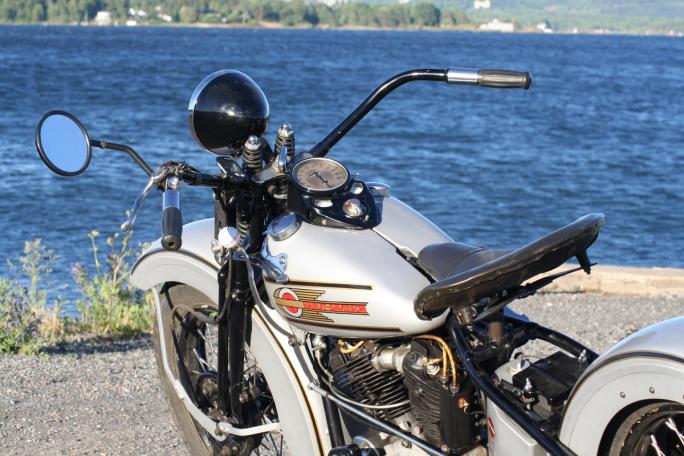
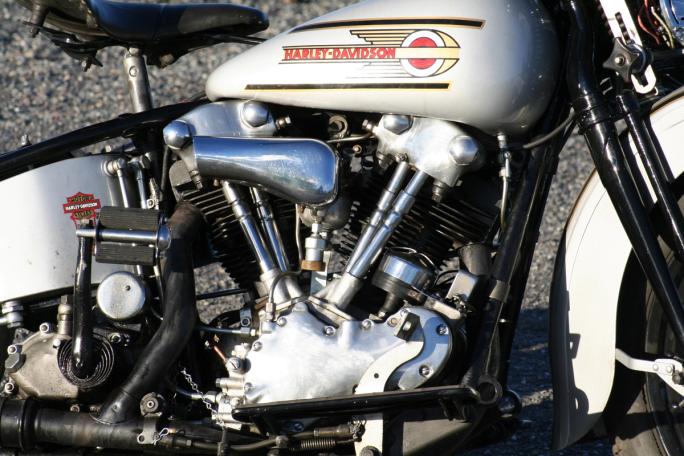
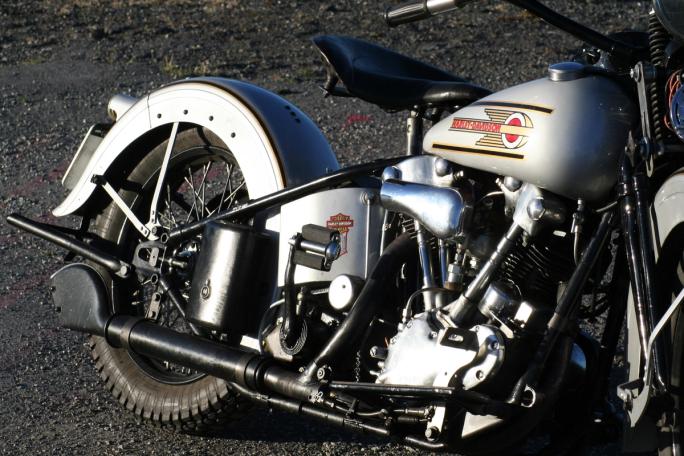
The E1000 featured a new streamlined design, with an Art Deco-style tank emblem. A number of technical innovations were of course to be found, including a double-tube frame. The engine received new cams and valve lifters, hidden under the knuckle-shaped rocker boxes. It was the design of these boxes that gave the bike the nickname “Knucklehead”. The E1000 was also the first Harley to feature a speedometer as standard equipment, and a closed oil system, with a return to a separate oil tank. Harley-Davidson now had a real trump card against Indian .
219 km/h
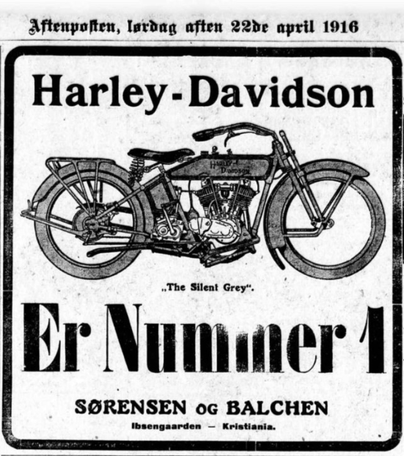
To really show what the bike was good for, Harley-Davidson contacted racing driver Joe Petrali. With Petrali behind the wheel, the Knucklehead achieved a top speed of a staggering 219 km/h on the Daytona track in 1937. Racing and top speed figures were the best advertising, even for Harley-Davidson , who in early marketing used the slogan "The silent grey fellow", in an attempt to reach the "man in the street" by marketing "civilized motorcycles". Or to put it another way; Milwaukee made ordinary machines for ordinary people. Incidentally, this year William A. Davidson, who was one of four who founded Harley-Davidson Motor Company in 1903, died.
Big Twin despite Black Tuesday
"Black Tuesday" that took place on Wall Street in New York on October 29, 1929 sent America into a deep and prolonged economic depression. Harley-Davidson had to endure a significant decline in sales figures. In 1929, Harley sold about 24,000 motorcycles, in 1932 only just over 7,000. And it was going to get even worse, because the following year, in 1933, the status at the end of the year showed only 3,700 machines sold. At the beginning of the 1930s, it became increasingly clear to the management in Milwaukee that a new and more modern engine was essential for Harley to stay ahead of the competition. Side-ventilated engines had their limitations in terms of power and performance, partly because the heat dissipation from the valves was limited. A new and more powerful engine therefore had to have overhead valves. The development of a top-ventilated v-twin with sump lubrication now went from the idea stage to the drawing board, and from there to the prototype stage. The old lubrication system, referred to as "total loss", was also not very practical if one was going for overhead valves and high power. Total loss was not very suitable for maintaining high oil pressure and sufficient lubrication. The fact that the oil ended up directly on the ground was also not a plus. Harley-Davidson now invested almost everything on the new engine, with great courage and faith in its own strength.
Test drive in the woods of Wisconsin
The test run, which was conducted in secret in the wooded hills of Wisconsin, was encouraging in terms of engine performance. The challenge was massive oil leaks from the rocker boxes. The new 4-speed gearbox also presented some challenges, but they were easy to solve, unlike the oil problem. The 1000cc was sump lubricated and the challenge was to prevent the oil pressure from blowing the oil out of the joints in the cylinder head. All the secrecy surrounding the new model is mainly due to Harley's bad experiences with the VL series from 1930. The VL had a number of technical problems, and Harley-Davidson incurred large warranty expenses as a result. Another such mistake had to be avoided at all costs. The test run in the terrain stressed the engine and all the weaknesses came to the surface. This allowed the engineers to weed out one fault after another, until the engine was holding oil.
Knucklehead was an immediate success
The secrecy surrounding the development of the Knucklehead lasted almost until its launch at Schroeder's Hotel in Milwaukee in November 1935. However, rumors had been circulating for a while, and the moment Walter Davidson and William Harley pulled the curtain on the top-vented model, a gasp went through the assembly, which consisted of most Harley dealers in the United States and members of the press. The excitement was great, and despite the fact that it was not possible to test drive the model, agreements were made for delivery to almost all of the dealers. Indian , which had been competing for customers with its side-vented "Chief", now had a challenger that it would eventually have to lose to. "Everyone" had to have the Knucklehead, which had a starting price of 380 USD. The model was available in three versions; the standard model E61 with a compression ratio of 6.5:1, the sports version EL61 with a 7:1 compression ratio, and the sidecar puller ES.
Five color combinations
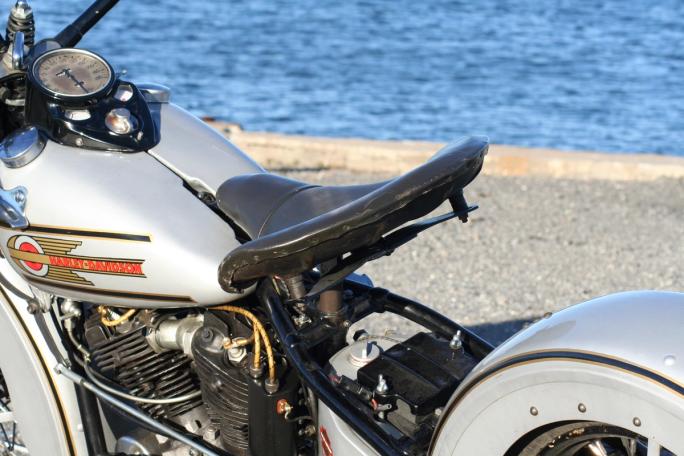
Customers could also choose between five different color combinations, all in so-called "Two tone" which were; Sherwood green with cream, Teak red with black, Dusk grey with Royal blue, Venetian Blue with Croydon cream and Maroon with Nile green. In the first model year, 1704 Knuckleheads were produced. As time went on, the Knucklehead became more powerful and it received a number of technical upgrades. In 1941, the engine was bored out from 61 to 74 cubic inches (1208 cc), which gave an output of 48 hp at 5000 rpm. The Knucklehead now had plenty of power for steady and comfortable cruising over longer distances. The model formed the basis for Harley's machines, both in terms of engine solution and design, right up until the Evolution which came out in 1984. The Knucklehead was produced from 1936-1947, and was replaced by the Panhead in 1948.
A/S Sorensen and Balchen
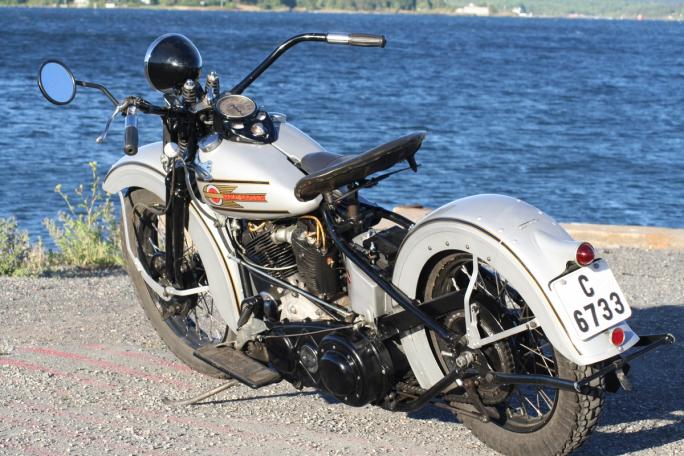
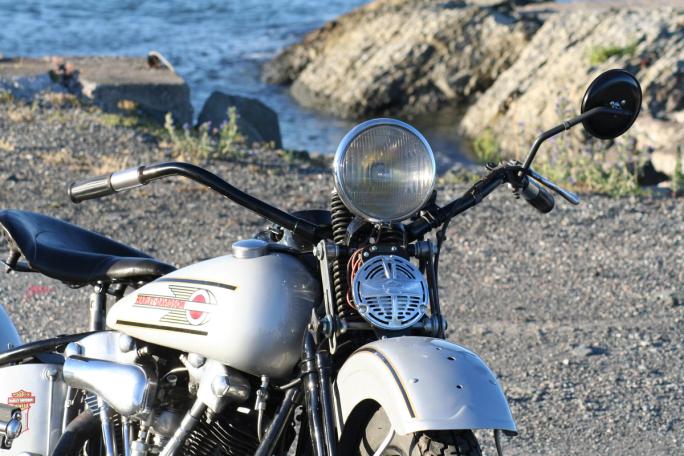
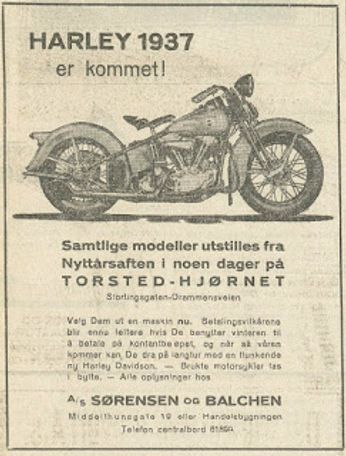
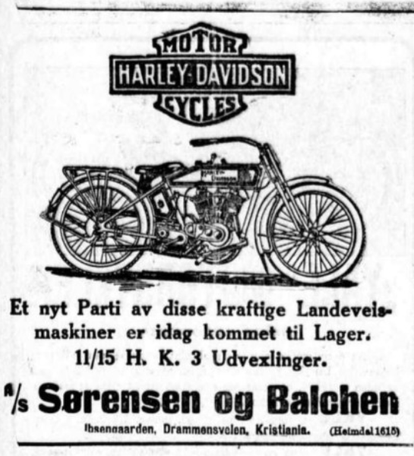
The old Oslo company A/S Sørensen og Balchen imported and sold Harley-Davidson from 1915 until the outbreak of World War II. They brought the bikes in on the boats belonging to the Norwegian American Line that ran between New York and Oslo. They brought in several Knuckleheads in the years just before the war, and one of these is the bike in this report, which came to Norway on March 31, 1937 on the American Line's boat "DS Stavangerfjord". This is a relatively rare Knucklehead because it is painted in "Police Silver", a color that only the American police were allowed to buy. The first owner was Arvid Fjell who lived in Sørkedalsveien in Vestre Aker Parish. Today, the Knucklehead has achieved an almost legendary status among Harley-Davidson's countless models. The engine design became the basis for all big-twins from Milwaukee until the 2000s. The long V-shaped cylinders with the connecting rod tubes on the right side have become the epitome of V-power. Knucklehead became PanHead (1948), PanHead became Shovelhead (1966), Shovelhead became Evolution (1984), and Evolution became Twin Cam (1998). Later the engine was water-cooled, but the basic concept is the same as it started with in 1936.
Technical data Harley Davidson EL 1000, 1937 model:
Engine: V-twin 45 degrees, OHV
Displacement: 60.33 cubic inches / 989 ccm
Power: 40 hp at 4800 rpm.
No. of gears: 4
Front tires: 4.00 x 18
Rear tires: 4.10 x 18
Electrical system: 6 Volt
Tank: 14 liters
Weight: 256 kg
Top speed: 161 km/h