
Brough Superior SS100
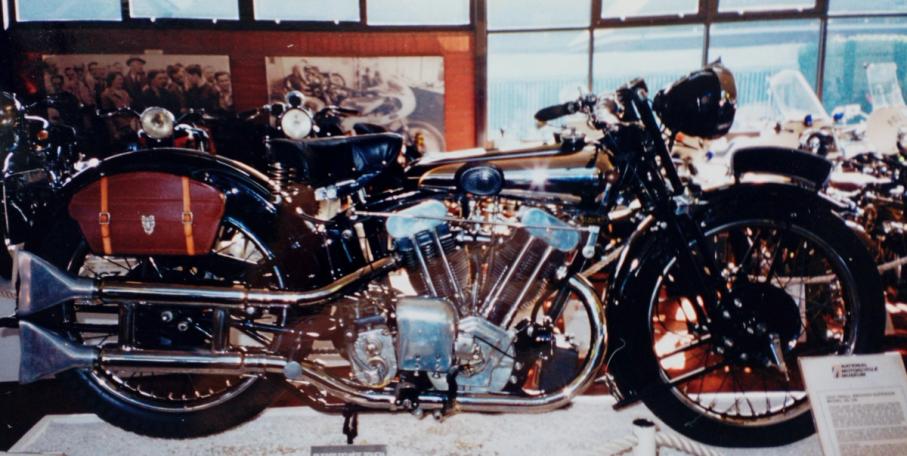
The SS100 was the top model, and when it first went on sale in 1924 it was good for 161 km/h.
Few, if any, motorcycle brands are as legendary as Brough Superior. Perhaps not surprising considering that design, power, performance and price made the brand the motorcycle's answer to Rolls-Royce; highly exclusive and reserved for customers with very deep pockets.
Rumor has it that Georg Brough (1890-1970) took his first motorcycle ride at the age of 10. The boy was very interested in motorcycles, and at the age of 18 he became a partner with his father who ran his own motorcycle production. However, young George had greater ambitions than his father, and in 1919 he ended the collaboration in favor of his own business, where he set himself the goal of building spectacular motorcycles under the name Brough Superior. The small factory was built in Nottingham, and the first model came in 1921. George's philosophy was to build a few copies that were extremely exclusive through spectacular design, and powerful V-twin engines purchased from, among others, JAPrestwich, better known as JAP, and from Matchless . For George, it was all about speed, which is something the motorcycles he built became world-renowned for.
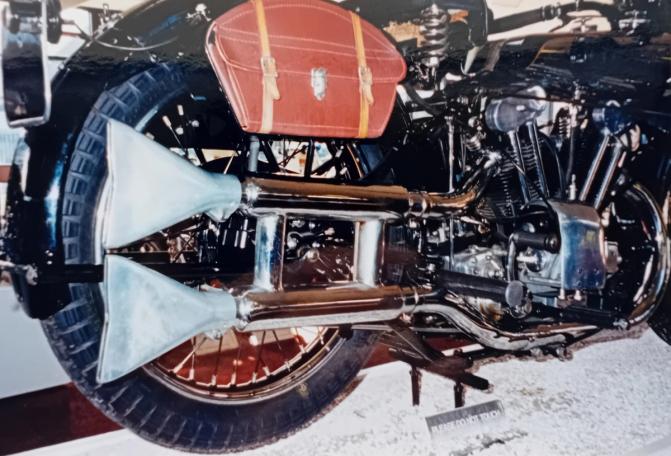
Brough Superior SS100; The Rolls-Royce of motorcycles
Rolls-Royce as a role model. That Brough Superior was in the same class as Rolls-Royce is not far-fetched, on the contrary. After George had compared his motorcycles to Rolls-Royce in his marketing, he was visited by two representatives from the exclusive car brand. They wanted to see what was going on, and when they arrived at the factory in Nottingham they saw an enthusiastic gentleman wearing white gloves preparing a petrol tank. They immediately concluded that motorcycles were built here to the same high standard that they themselves stood for at home in the car factory. They nodded in approval, and accepted that Georg Brough compared his motorcycles to their car brand. In many ways this was a seal of quality that both manufacturers enjoyed.
Sir Lawrence of Arabia. Although Brough Superior claimed the lead in racing, it was through famous personalities that the brand received the most attention. George Brough's best-known customer was undoubtedly the English author, archaeologist and officer, Thomas Edward Lawrence, better known as Lawrence of Arabia. He was not short of money, on the contrary. As the hero and adventurer that he was, he appreciated speed and excitement, and the man owned no less than seven Brough Superiors, six of which were the fastest and most exclusive model, the SS100. Lawrence died on May 19, 1935, when he, in the saddle of his SS100, drove off the road to avoid colliding with two boys on a pedal bike.
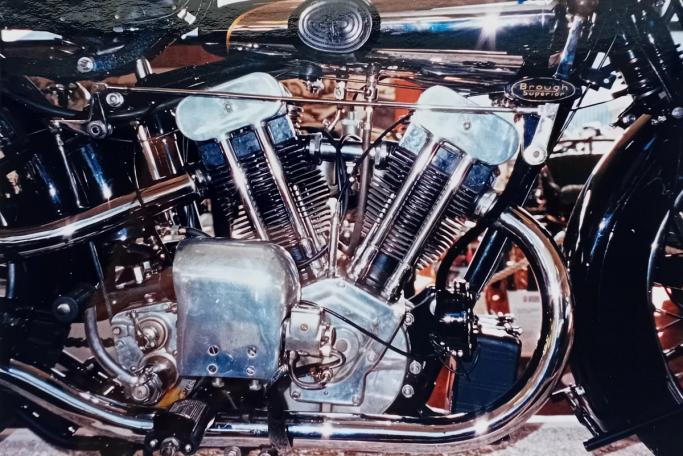
The V-twin delivered a whopping 74 hp, which was enormous power for a motorcycle in 1934.
200 km/h. throughout the 1930s, George refined the top model SS100, and in 1934 an updated version of the model was released. With a whopping 74 hp v.6200, it was good for a top speed of a staggering 200 km/h. There was no one above, no one next to, and hardly anyone close. If we turn back time to the beginning of the 20th century when the first motorcycle manufacturers established themselves, and draw a line to the present day, George Brough's machines are in a special position. The motorcycles from the small manufacturer in Nottingham have achieved iconic status, and last but not least astronomical sums in the rare cases they appear for sale, often at exclusive auction houses. And it was precisely the high price tag when they were new that was the main reason why the market for this type of motorcycle disappeared at the outbreak of World War II. Thus, George Brough ended the production of motorcycles in 1940. Even well-off customers had to think about what to spend their money on when war was a fact.